ATTAIN-1 tested a practical scientific question: how much weight would adults without diabetes lose when assigned to daily oral orforglipron rather than placebo, alongside diet and physical activity support? Among 3,127 randomized participants, the highest study-dose group lost an estimated 11.2% of starting body weight at 72 weeks, compared with 2.1% with placebo. That is a group-level clinical endpoint—not a prediction for every person, a measure of everyday well-being, or evidence about a particular care provider.
Orforglipron is now FDA approved in the United States as Foundayo, with initial approval in 2026. The investigational formulation used in ATTAIN-1 had different dose numbers from the marketed tablets. This analysis uses the indexed primary research abstracts and available official FDA and DailyMed material; it does not claim examination of the research articles’ complete protocols or supplements. The central task is to understand what was measured, how missing observations were handled, and which questions remain unanswered.
ATTAIN-1: mean weight change with the studied oral formulation
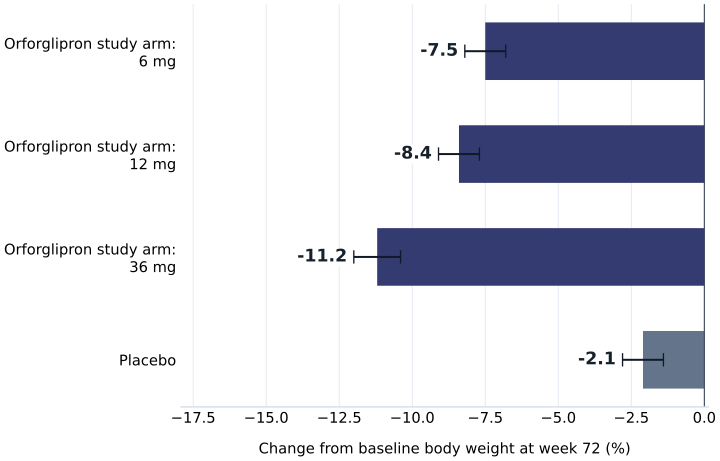
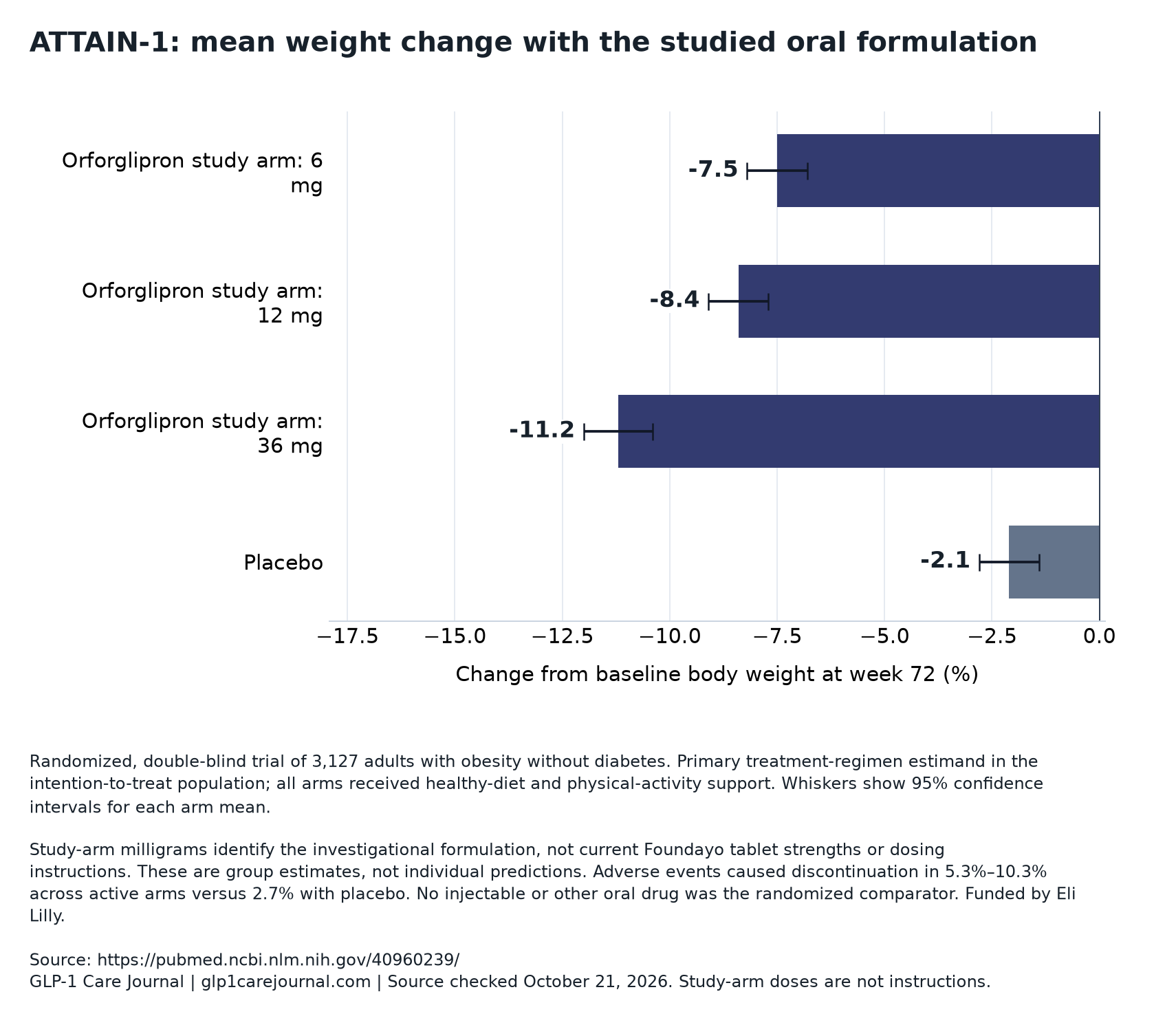
Randomized, double-blind trial of 3,127 adults with obesity without diabetes. Primary treatment-regimen estimand in the intention-to-treat population; all arms received healthy-diet and physical-activity support. Whiskers show 95% confidence intervals for each arm mean.
Study-arm milligrams identify the investigational formulation, not current Foundayo tablet strengths or dosing instructions. These are group estimates, not individual predictions. Adverse events caused discontinuation in 5.3%–10.3% across active arms versus 2.7% with placebo. No injectable or other oral drug was the randomized comparator. Funded by Eli Lilly.
Source 1Download the source-labeled chart (PNG) · Download the data (CSV)
| Study group | Reported value | 95% confidence interval |
|---|---|---|
| Orforglipron study arm: 6 mg | -7.5 | -8.2 to -6.8 |
| Orforglipron study arm: 12 mg | -8.4 | -9.1 to -7.7 |
| Orforglipron study arm: 36 mg | -11.2 | -12.0 to -10.4 |
| Placebo | -2.1 | -2.8 to -1.4 |
Sections in this article
Who entered ATTAIN-1, and what assignment meant
ATTAIN-1 was randomized and double-blind: treatment was assigned by chance, and participants and investigators were masked to assignment. The allocation ratio was 3:3:3:4 across investigational orforglipron doses of 6 mg, 12 mg, and 36 mg and placebo. These numbers identify research arms, not present-day dosing instructions. All groups received diet and physical activity support, so the comparison was medication plus that background intervention versus placebo plus the same background intervention.
The primary abstract describes adults with obesity without diabetes. The official label gives fuller eligibility: obesity, or overweight with at least one weight-related condition, excluding type 2 diabetes. Participants had a mean age of 45 years, a mean starting weight of 103.2 kg, and a mean BMI of 37. Sixty-four percent were female. Those averages describe the sample; they do not establish identical effects across ages or starting weights.
Follow-up for the primary endpoint lasted 72 weeks, approximately 17 months. Eli Lilly funded the trial. Randomization supports a causal comparison of assigned treatment within this study, but it does not make the sample representative of every adult seeking weight care, particularly people with diabetes, who were studied separately.
Source 1 Source 2The primary estimate includes more than uninterrupted treatment
The primary endpoint was percentage change in body weight from baseline to week 72, evaluated using the treatment-regimen estimand in the intention-to-treat population. An estimand specifies the treatment question a statistical analysis aims to answer. Here, the focus was assignment to a treatment regimen, rather than a narrower question about what would happen if everyone remained on treatment throughout.
That distinction matters because treatment discontinuation occurred. Intention-to-treat means participants remain associated with their randomized group for analysis; it does not mean every week-72 weight was directly measured. In Trial 1, the label reports missing endpoint measurements for 24% of placebo participants and 14%–16% of participants across the active groups. Missing values were estimated using multiple imputation, a method that creates plausible values from observed study data under specified assumptions.
The abstract’s 11.2% highest-arm result is therefore the appropriate anchor for discussing its primary finding. A larger number answering a different adherence-related question should not replace it. The label separately reports 11.1% for Trial 1 under its stated analysis. These closely aligned estimates should remain attached to their respective reports rather than being silently blended.
Source 1 Source 2Reading the dose-group results without overstating precision
All three active groups lost more weight on average than placebo. The abstract reports statistical significance for each placebo comparison. The table preserves the abstract’s estimates and confidence intervals, which describe uncertainty around group means—not the range of outcomes experienced by individual participants.
Subtracting the placebo mean gives estimated additional reductions of 5.4, 6.3, and 9.1 percentage points across the three research arms. These are editorial arithmetic differences, not separately reported confidence intervals. An 11.2% reduction versus a 2.1% reduction is a 9.1-percentage-point difference, not merely a 9.1% relative improvement.
For scale only, an 11.2% reduction from a hypothetical starting weight of 100 kg equals 11.2 kg; 2.1% equals 2.1 kg. That illustration translates the endpoint into familiar units without predicting an individual result. The ordered averages suggest greater weight reduction at higher studied doses, but placebo comparisons alone do not establish the size or certainty of every active-dose comparison.
| Research assignment | Mean weight change | 95% confidence interval |
|---|---|---|
| Orforglipron 6 mg daily | −7.5% | −8.2% to −6.8% |
| Orforglipron 12 mg daily | −8.4% | −9.1% to −7.7% |
| Orforglipron 36 mg daily | −11.2% | −12.0% to −10.4% |
| Placebo daily | −2.1% | −2.8% to −1.4% |
Threshold results show variation hidden by the mean
Average change cannot show how frequently participants reached a particular degree of weight reduction. In the highest investigational-dose group, 54.6% reached at least 10% reduction, compared with 12.9% on placebo. At the 15% threshold, the proportions were 36.0% and 5.9%; at the 20% threshold, they were 18.4% and 2.8%.
These categories are nested. Someone who lost at least 20% also belongs to the groups losing at least 15% and at least 10%. Adding the three percentages would count some participants repeatedly. The corresponding placebo differences are 41.7, 30.1, and 15.6 percentage points, respectively, calculated directly from the abstract.
The thresholds also reveal why a mean is not a promise. Even in the highest study-dose group, nearly half did not reach 10% reduction under this analysis. The abstract does not describe every reason for that variation or provide a validated way to predict an individual response. Treatment exposure, biological differences, and other explanations require evidence beyond the threshold totals.
Source 1Physical measurements and lived experience are different outcomes
ATTAIN-1 also reported improvements versus placebo in waist circumference, systolic blood pressure, triglycerides, and non-HDL cholesterol. These measurements broaden the evidence beyond the scale. They are not, however, proof that this trial reduced heart attacks, strokes, mortality, or every obesity-related complication.
The label’s Trial 1 analysis reports a 10.0-cm waist reduction in the highest-dose group versus 3.1 cm with placebo, an adjusted difference of −6.9 cm (95% CI, −7.8 to −6.0). Its systolic blood pressure difference was −4.9 mm Hg (−6.1 to −3.8), although that comparison was not controlled for multiple testing. Pulse moved in the other direction: the adjusted difference was an increase of 4.1 beats per minute (3.1 to 5.0).
Feeling more mobile, finding meals easier to manage, or experiencing disruptive nausea are distinct patient experiences. The ATTAIN-1 abstract does not quantify all such outcomes. The same endpoint discipline applies to ESSENCE’s liver-biopsy evidence: an improvement in one measured domain should not be expanded into an unmeasured clinical benefit. A one-page visit note can preserve symptoms and functional changes alongside numerical measurements.
Source 1 Source 2Discontinuation is part of the treatment result
Adverse events caused treatment discontinuation in 5.3%–10.3% of the active groups versus 2.7% with placebo. The abstract gives this as a range rather than assigning each percentage to a named dose. Gastrointestinal effects were most common and mostly mild to moderate, but the discontinuation total should not be described as entirely gastrointestinal.
All-cause treatment discontinuation is a different measure. The label reports that 22%–24% of active-treatment participants in Trial 1 discontinued trial medication, compared with 30% receiving placebo. Those totals include reasons beyond adverse reactions. Neither stopping medication nor lacking a final weight measurement automatically means a participant disappeared from every aspect of study follow-up.
The label’s pooled two-trial safety data provide additional context, not ATTAIN-1-only rates: gastrointestinal reactions occurred in 60%–69% of active-treatment participants versus 37% with placebo, and severe gastrointestinal reactions occurred in approximately 3% versus 1%. The pool includes people with type 2 diabetes. Keeping the population attached to each number prevents a broader safety database from being mistaken for a single trial.
Source 1 Source 2Foundayo’s current label adds specific safety obligations
Foundayo is an approved oral GLP-1 receptor agonist, meaning it activates the human receptor for glucagon-like peptide-1. Its boxed warning addresses thyroid C-cell tumors. Other GLP-1 drugs active in rodents produced these tumors; orforglipron is not pharmacologically active in rats or mice and did not produce tumors in those studies. The relevance of the receptor-dependent rodent findings to humans remains unknown.
The label contraindicates use in people with a personal or family history of medullary thyroid carcinoma or multiple endocrine neoplasia syndrome type 2, and in those with serious hypersensitivity to its ingredients. It also identifies pancreatitis, severe gastrointestinal reactions, kidney injury associated with volume depletion, and gallbladder disease as concerns. Approval does not justify a blanket description of the medicine as safe.
In pooled weight-management trials, acute kidney injury was reported in 0.2% with orforglipron versus 0.05% with placebo. Gallstones occurred in 1.0% versus 0.7%, and acute cholecystitis in 0.4% versus 0.3%. Six active-treatment patients had adjudicated pancreatitis, compared with one placebo patient who had two events. These uncommon events deserve attention, while their small numbers limit precision about relative differences.
Source 2Research milligrams are not marketed tablet strengths
The current label explicitly states that effectiveness and safety were established using an investigational orforglipron formulation, with results presented as equivalent marketed dosages. The 6-mg, 12-mg, and 36-mg numbers in the research abstract therefore should not be read as Foundayo tablet strengths or transferred into a personal regimen.
This is more than a naming detail. A milligram describes an amount of substance, while the formulation affects how a medicine is delivered and absorbed. Regulatory documentation supplies the bridge between the studied and marketed products. A reader should not construct a conversion from the trial abstract or assume that a different product sharing an ingredient name reproduces the tested exposure.
A usable medication record can distinguish product name, formulation, route, and prescribed strength from historical research doses. FDA also warns that compounded GLP-1 products do not undergo its premarket review for safety, effectiveness, and quality. ATTAIN-1 does not establish outcomes for compounded products, alternative formulations, or a provider’s own preparation.
Source 1 Source 2 Source 3OASIS 4 supplies context, not an oral-drug ranking
OASIS 4 studied daily oral semaglutide, not orforglipron. It randomized 307 adults without diabetes at 22 sites in four countries, with 205 assigned to semaglutide and 102 to placebo. The study lasted 71 weeks, but its coprimary weight endpoints were assessed at week 64. Novo Nordisk funded the trial.
At week 64, estimated mean weight change was −13.6% with oral semaglutide versus −2.2% with placebo, a difference of −11.4 percentage points (95% CI, −13.9 to −9.0). A physical-function questionnaire also improved significantly, although the abstract does not give the effect magnitude. Gastrointestinal adverse events occurred in 74.0% versus 42.2%. Neither those rates nor the weight averages establish superiority over ATTAIN-1’s drug.
A genuine direct comparison appears in SURMOUNT-5, but it compared weekly injected tirzepatide with weekly injected semaglutide—not the oral medicines. It was randomized and open-label, unlike the blinded oral placebo trials. Its design illustrates why a shared comparator within one trial provides stronger comparative evidence than placing results from separate studies side by side.
| Trial and population | Intervention and comparator | Weight endpoint |
|---|---|---|
| ATTAIN-1: 3,127 adults without diabetes | Daily oral investigational orforglipron versus placebo | Week 72: highest arm −11.2% versus −2.1% |
| OASIS 4: 307 adults without diabetes | Daily oral semaglutide 25 mg versus placebo | Week 64 within a 71-week study: −13.6% versus −2.2% |
| SURMOUNT-5: 751 adults without diabetes | Weekly subcutaneous tirzepatide 10 or 15 mg versus semaglutide 1.7 or 2.4 mg, at maximum tolerated doses | Week 72: −20.2% versus −13.7% |
What the findings imply for follow-up documentation
Editorial interpretation: a useful follow-up record keeps three tracks separate. Clinical endpoints include weight and blood pressure; patient-experienced outcomes include symptoms and daily function; care-process records document contacts, medication changes, and unresolved questions. ATTAIN-1 provides evidence about assigned treatment under trial conditions, not evidence that any commercial service reliably maintains all three tracks.
Missing endpoint data in the trial make continuity a concrete issue rather than an administrative afterthought. Outside research, a gap in measurement can make it difficult to distinguish a treatment change from an undocumented interval. A care-transition record and a refill calendar with space for questions are organizational tools, not methods proven by ATTAIN-1 to improve weight outcomes.
Editorial interpretation: when comparing contracts, the relevant documentary questions include what follow-up is described, how questions are handled, and which charges or cancellation terms are written down. The Ro review and Found review can be starting points for checking documentary terms only. These links do not establish availability of the studied product, condition-specific services, or trial-like outcomes. No cost-effectiveness conclusion follows from ATTAIN-1.
Source 1 Source 2 Source 3Questions about the evidence
Does 11.2% mean most participants lost exactly that much?
No. It is an estimated group mean under the primary treatment-regimen analysis. The responder thresholds show substantial variation: 54.6% of the highest study-dose group reached at least 10% reduction, while 18.4% reached at least 20%. The confidence interval around the mean is not an individual prediction interval.
Source 1Why emphasize missing measurements if the trial was randomized?
Randomization strengthens the comparison at assignment, but it cannot supply measurements that were never obtained. The analysis estimated missing week-72 weights using observed data and assumptions. Unequal missingness between groups makes those methods important to interpretation; it does not by itself invalidate the trial.
Source 2Is Foundayo still investigational?
No. The current official label records initial US approval in 2026. The historical trial used an investigational formulation, which explains why the abstract’s dose numbers differ from marketed tablet strengths. Historical research language should not be mistaken for current regulatory status or used to select a personal dose.
Source 2 Source 1Did oral semaglutide outperform orforglipron?
That conclusion is not established by these studies. OASIS 4 and ATTAIN-1 enrolled different samples and used different assessment schedules and analyses. Each demonstrated benefit against its own placebo group. A direct randomized comparison of the oral interventions would address comparative effectiveness more convincingly than cross-trial arithmetic.
Source 1 Source 4What remains unknown after 72 weeks?
These reports do not establish individual long-term trajectories, outcomes after treatment ends, or reductions in major cardiovascular events from ATTAIN-1. They also do not quantify every aspect of daily function or treatment burden. Longer follow-up and studies designed around those outcomes are needed; provider-specific results require their own evidence.
Source 1 Source 2Editorial assessment
ATTAIN-1 provides strong randomized evidence that daily oral orforglipron produced greater average weight reduction than placebo over 72 weeks in adults without diabetes receiving lifestyle support. Its value lies not only in the mean result but also in the distribution of responses, treatment discontinuations, and explicit handling of missing measurements. Current Foundayo labeling supplies the regulatory and safety context that the historical abstract alone cannot. The practical interpretation is to keep measured benefit, experienced burden, and follow-up documentation distinct—and not convert a drug-trial result into a promise about another formulation or a commercial care plan.
Research access and limitations
The research analysis relies on indexed primary-report abstracts, supplemented by the official Foundayo label and FDA material. Complete research protocols and supplements were not examined. Label safety pools include a separate diabetes trial and are identified as pooled rather than ATTAIN-1-only findings. Cross-trial comparisons are contextual, not estimates of comparative oral-drug efficacy.
Source notes
Scientific sources checked October 21, 2026. Earlier research and provider sources retain their dated histories below. Provider pages document advertised terms. Study summaries identify the scope of our review.
- Orforglipron, an Oral Small-Molecule GLP-1 Receptor Agonist for Obesity Treatment.Indexed original research abstract · Checked 2026-10-21
- DailyMed - FOUNDAYO- orforglipron tablet, film coatedOfficial page retrieved in full · Checked 2026-10-21
- FDA — unapproved GLP-1 drug concernsSafety information · Checked 2026-10-21
- Oral Semaglutide at a Dose of 25 mg in Adults with Overweight or Obesity.Indexed original research abstract · Checked 2026-10-21
- Tirzepatide as Compared with Semaglutide for the Treatment of Obesity.Primary research or official information · Checked 2026-10-21